- Different leaf positions, due to variations in light exposure and nutrient distribution, form a significant gradient from physical density to chemical composition, directly determining the body, richness, and burning rate of the smoke.
- The time window of maturity determines the extent of the leaf's transition from nitrogen metabolism to sugar metabolism — too early brings greenness, too late brings decline; precise grasp of the window is key to quality control.
- The K/Cl ratio, sugar/nicotine ratio, and physical porosity constitute the underlying control logic of combustion and smoke release, determining whether burning is stable and smoke is harmonious.
- Theory must ultimately be applied in the field. Hand feel — pressing elasticity, vein hardness, leaf tip angle — is the final basis for judging maturity and harvest timing.
Technical Influence of Leaf Plucking Timing and Leaf Position on Burn Time and Smoke Characteristics
In the early morning of the Baoshan tobacco region in Yunnan, when the first ray of sunlight penetrates the mist and falls upon the tobacco fields of the Red River Valley, experienced leaf pluckers are not merely "looking" at color—they are "sensing" life. The thickness felt when fingers glide across leaf veins, the angle at which leaves naturally droop in the air, and that hint of warm-tinted dark yellow together constitute the most complex technical proposition in tobacco production: how to lock in the final product's combustion performance and smoke quality through precise control of leaf plucking timing and leaf position.
This is not a simple agricultural operation. It is a precise control of plant metabolites and physical structures highly coupled across temporal and spatial dimensions.
I. The Physical and Chemical Logic of Leaf Position Gradient: Constructing the "Skeleton" and "Flesh" of Smoke
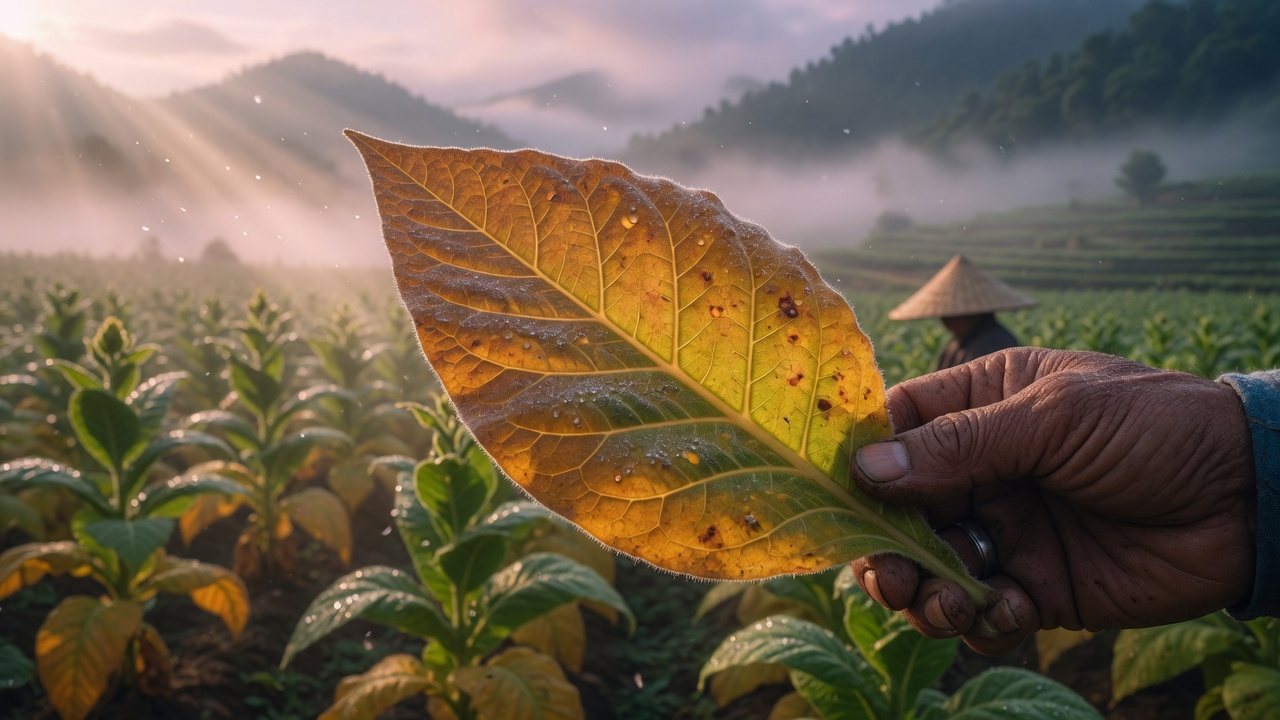
During the growth process of the tobacco plant, due to differences in light intensity, nutrient distribution, and hormone levels, a very distinct leaf position gradient is formed. This gradient is not only reflected in visible morphological differences but, more deeply, determines the thermodynamic performance of tobacco leaves as combustion fuel and their chemical characteristics as aroma carriers.
1. Upper Leaves (Ligero/Tips): The "Skeleton" and Powerful Drive of Smoke
Upper leaves are located at the top of the plant, receiving intense direct sunlight for prolonged periods. Their cell walls thicken and their tissue structure becomes extremely dense. This physical characteristic directly results in their very high density. In actual combustion tests, we observed that the smoldering time of upper leaves is significantly longer than that of other parts. This "slow-burn" characteristic is the core of their role as the smoke's "skeleton."
From a chemical composition perspective, upper leaves are the concentration center of nicotine. In test data from Baoshan, high-quality upper leaves typically contain 5.5%-7.2% nicotine, far higher than middle and lower leaves. This high nicotine concentration gives the smoke a very strong impact and punch. However, high density also brings challenges: if the K/Cl ratio is not properly controlled, upper leaves are prone to blackening or extinguishing during combustion. Their combustion process is more like a deep "smoldering," providing sustained strength but also placing higher demands on blending techniques.
2. Middle Leaves (Viso/Cutters): The "Golden Balance Point" of Sensory Quality
If upper leaves are the skeleton, then middle leaves are the "flesh" of the smoke. Middle leaves are at the center of nutrient distribution during the growth cycle, achieving a perfect balance in thickness, density, and chemical composition harmony.
In technical parameters, the sugar/nicotine ratio and potassium/chlorine ratio of middle leaves are typically in the optimal range. Their smoldering time is extremely stable, usually maintained between 130-160 seconds, with uniform burning speed and no tendency to fluctuate. This stable combustion performance ensures that during smoke release, the ratio of tar to nicotine remains in an extremely balanced state.
From a sensory perspective, middle leaves contribute the richest aroma precursor substances (such as carotenoids and polyphenols). They not only provide sufficient aroma volume but, more importantly, their smooth, delicate, and highly harmonious smoke is the foundation of high-end cigarette and cigar quality.
3. Lower Leaves (Seco/Lugs): Combustion "Filler" and Mild Base Tone
Lower leaves grow at the base of the plant, with limited light exposure and an earlier growth cycle. Their leaves are relatively thin, with loose tissue structure and low physical density. This characteristic determines their faster burning speed, shorter smoldering time, and lighter combustion process.
At the chemical level, lower leaves have lower nicotine content (typically between 2.0%-3.5%), but their reducing sugar ratio is relatively high. This gives lower leaves a sensory smoke profile characterized by mildness, low irritation, and insufficient strength. During blending, lower leaves are often used as filler material, utilizing their fast-burning and mild smoke characteristics to adjust the overall smoke balance, avoiding excessive heaviness or harshness.
II. Metabolic Transition on the Timeline: The Decisive Role of Plucking Timing
Leaf plucking timing is essentially the interception of the plant's metabolic transition from "growth mode" to "maturation/senescence mode." Small deviations in maturity, by altering the ratio of internal components, can have cascading effects on combustion and smoke.
1. Premature Harvest: The "Technical Disaster" of Immaturity
Premature harvest caused by weather conditions during the harvesting season (such as continuous rain forcing the harvest window to be moved earlier) is a major taboo in production. Immature leaves contain high levels of chlorophyll and unconverted proteins and starches.
From a combustion perspective, high protein and chlorophyll content leads to incomplete combustion, producing large amounts of black ash and off-flavors. More critically, the K/Cl ratio of immature leaves is often extremely unbalanced, resulting in very short smoldering time and highly unstable combustion, with a high tendency to "extinguish mid-burn." Sensorially, these leaves release a strong "green off-flavor," with intense irritation and unpleasant bitterness, completely destroying smoke harmony.
2. Optimal Ripeness Harvest: The "Golden Window" of Metabolites
Optimal ripeness refers to the stage when tobacco leaves have completed the transition from nitrogen metabolism to sugar metabolism, at which point reducing sugars, nicotine, and mineral elements have reached their most ideal ratio.
At this stage, the leaf midrib begins to turn white and shiny, and the leaf color shifts from green to yellow. Behind these visual signals is the moderate softening of cell wall structure and the peak state of chemical composition. Optimally ripe leaves have the longest and most uniform smoldering time. This is because the potassium ion concentration and tissue looseness have reached a perfect balance point, ensuring both oxygen permeation efficiency and maintaining combustion thermal inertia. The smoke released at this time has abundant aroma, moderate concentration, and a clean aftertaste.
3. Over-Ripe Harvest: The "Irreversible Deterioration" of Quality
When harvesting is too late and the leaves enter an over-ripe or even senescent stage, the accumulated reducing sugars begin to degrade and internal components undergo oxidation. This not only leads to fluctuations in nicotine content but also causes the collapse of leaf tissue structure. Over-ripe leaves often exhibit a "hollow fire" phenomenon during combustion: extremely fast burning speed, but rapidly declining heat retention, poor ash quality, and smoke that appears flat, weak, and even carries a stale off-flavor.
III. Underlying Driving Mechanisms: From Ion Balance to Physical Porosity
To understand the above phenomena, we must delve into the microscopic chemical and physical mechanisms.
1. K/Cl Ratio: The "Voltage Stabilizer" of Combustion
Potassium ions (K+) play a role in promoting combustion in tobacco leaves, helping maintain cell wall charge balance and facilitating the pyrolysis of organic matter. Chloride ions (Cl-) and sulfur (S), on the other hand, tend to inhibit combustion and cause combustion residues (ash) to appear black or dark in color.
Our field observations found that a high-quality middle leaf typically maintains a K/Cl ratio that supports long, uniform smoldering. Once chlorine content increases, the heat release during combustion becomes disordered, causing burning rate fluctuations that directly affect the continuity of smoke release.
2. Sugar/Nicotine Ratio and Smoke pH Value
Sugar is not only an energy source but also a "lubricant" for smoke mouthfeel. Reducing sugars participate in complex chemical reactions during combustion and can regulate the pH value of the smoke. An ideal sugar/nicotine ratio can neutralize the harsh pungency brought by nicotine, giving the smoke a rounded, full tactile sensation in the mouth. If sugar content is too low (as in immature leaves), the smoke will appear sharp and harsh on the throat; if sugar content is too high with insufficient nicotine, the smoke will appear weak and lacking in strength.
3. Physical Porosity and Oxygen Diffusion
The physical structure of the leaf, especially the porosity between cells, directly determines the diffusion rate of oxygen to the combustion core zone. The high density of upper leaves means lower porosity, which limits rapid oxygen entry and leads to their characteristic "deep smoldering" feature; while the loose structure of lower leaves allows rapid oxygen penetration, achieving faster burning rates.
IV. Field Practice: Experience, Details, and Precision Control
As technical professionals, we must realize that all theories ultimately must be applied to those hands that "sense" the leaves in the field.
I recall one autumn in 2018 when the Baoshan region in Yunnan experienced rare continuous heavy rainfall, which directly disrupted the original middle leaf harvesting schedule. At that time, many novice leaf pluckers judged maturity solely based on leaf color, resulting in large quantities of middle leaves being harvested before their color had fully turned yellow. Consequently, after curing, that batch of tobacco not only had a smoldering time nearly 20 seconds shorter than expected but also exhibited a distinct, hard-to-mask "green flavor" in the smoke.
This lesson taught us: Looking at color is only a preliminary judgment; feeling the "sinew" and "flesh" of the leaf is the core skill.
True technical professionals, when judging middle leaves, gently press the leaf with their fingers to feel the ratio of thickness to elasticity; observe the hardness of the leaf veins; and even use the angle of the leaf tip droop as an auxiliary judgment. What we must pursue is finding, in every plant and every leaf, that moment when chemical composition and physical structure are perfectly coupled.
Precise leaf plucking is a respect for the laws of natural metabolism and the highest tribute to the art of tobacco. Only by mastering this ultimate control of timing and position can we consistently release that rich and harmonious flavor belonging to a golden era in every cigarette.